
As food waste is 70% water, sending food waste for incineration requires more energy to burn so recycling is a more efficient method of disposal.
Food waste recycling
Why should I recycle my food?
Around 4.7 million tonnes of food is thrown away each year, and did you know that food waste causes harmful gases that contribute to climate change?
But here’s the thing – we can turn that waste into something useful because recycled food waste can be transformed into energy, and food for soil – which helps farmers grow crops that end up back in our fridge, going full circle.
Plus, with weekly collections, your food leftovers will spend less time in the maroon bin -meaning less smells and more room for household waste.
You can find out more about the recycling journey here.
How do I recycle my food
It’s really simple to recycle your food waste, all you need to do is put a liner in your indoor food caddy and empty any food waste into it.
When your indoor caddy is full, tie the bag tightly and put it into the outdoor caddy.
If you’re short on caddy liners, tie a bag around the handle of your outdoor caddy and we’ll leave you with more.
Check out our video for more information
What do I need to recycle my food?
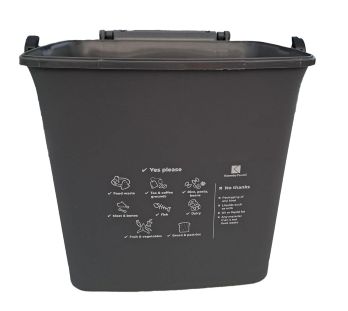
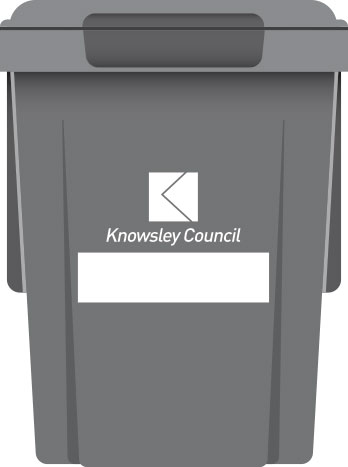
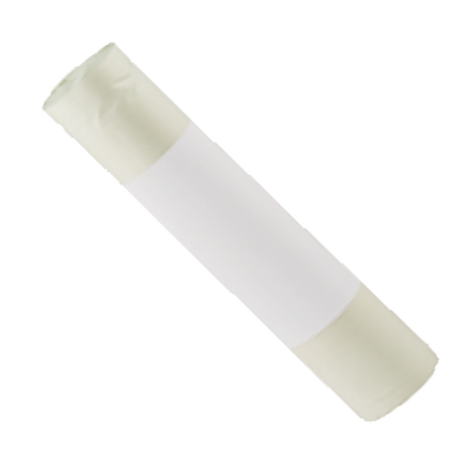
All households should have the below items, if you didn’t receive your food caddy or if you have moved into a new property, you can order a caddy here.
|
|
|
There will also be an instructional leaflet telling you everything you need to know about the new service and your new April 2026 – March 2027 collection calendar which can also be found on our website.
Who can recycle their food waste?
For now, the service is only available to households across Knowsley, however, we will be looking to introduce food waste recycling to flats later in the year.
What can go into my food caddy?
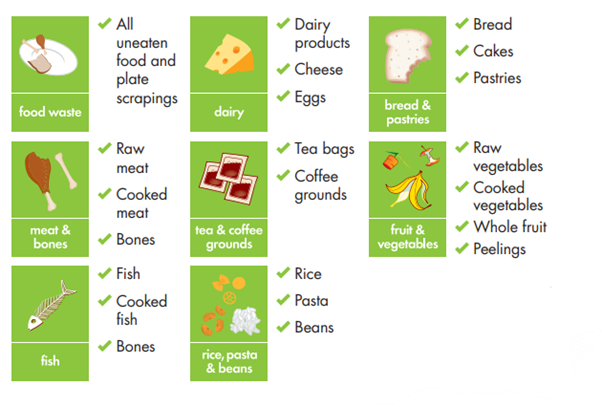
Please do not put in your caddy
- Packaging of any kind
- Liquids such as milk
- Oil or liquid fat
- Any material that is not food waste
What should I do on collection day?
- Put a liner in your indoor food caddy and empty any food waste into it.
- When your indoor caddy is full, tie the bag tightly and put it into the outdoor caddy.
- If you're short on caddy liners, tie a bag around the handle of your outdoor caddy and we’ll leave you with more.
- Leave your outdoor food caddy at the side of your other bins on the kerbside by 7am on your collection day.
- Please make sure your outdoor food caddy lid is closed with the handle in the locked upright position.
- Put your caddy back safely after collection.
More information
If you have any queries, get in touch and our team will be happy to help you.
Food recycling FAQs
Still have a question? Check out our most commonly asked ones below:
Why should I recycle food waste?
What happens to food waste once collected?
Your food waste is taken to a local transfer station, then sent to an Anaerobic Digestion (AD) facility, where it goes through an eight-step specialist process, called Anaerobic Digestion.
Anaerobic Digestion is a natural process that biologically breaks down organic material to generate large amounts of biogas - a combination of methane and carbon dioxide. It works in a similar way to a compost heap, only on an industrial scale, and because of the lack of oxygen, the biogas is captured, rather than it being lost in the atmosphere. It then goes through a refining process to remove carbon dioxide and volatile organic compounds; an odorant is added to the biomethane before it is pumped directly into the National Gas Grid.
What if I don’t produce any food waste?
Remember there is no amount too small. Unavoidable items – like banana skins, peelings, bones, eggshells, tea bags and coffee grounds – can go into your food caddy.
I don’t have time to do this – why should I?
You’re already producing food waste, it’s going in your household waste bin, so this is just a different container. Separate food waste collections are required by law and are the best way to stop food waste producing harmful gases, turning it into useful energy instead.
How will you collect my food waste?
Food will be collected from the kerbside in your 23l outdoor food caddy. The lid of the caddy locks when the handle is upright. Crews will empty your caddy into a wheelie bin or directly into the collection vehicle. Your caddy will be returned to your property.
How often will my food waste be collected?
Weekly, on the same day as your grey and maroon bins.
I don’t have space for a caddy, what should I do?
Many residents keep their caddy:
- Under the sink
- Beside the kitchen bin
- On the countertop
If preferred, you can use your own container indoors as long as the food waste is tied securely in a liner and transferred to your outdoor caddy.
Will the food in my bin smell?
Not if you empty your kitchen caddy regularly into the outdoor food caddy and tie up the liners.
What things can be put in the household food waste collection service?
- All uneaten food and plate scrapings
- Baked goods such as bread, cakes and pastries
- Dairy products, eggs and eggshells
- Fruit and vegetables including raw and cooked vegetables and peelings
- Out-of-date or mouldy food
- Raw and cooked meat or fish, including bones
- Tea bags and coffee grounds
All food waste should be removed from packaging
Will there be a charge for food waste collection?
No, food collections are included in the standard waste collection service.
Why can’t I put food waste in my general waste bin?
New government legislation requires councils to collect food waste separately. Recycling your food waste is better for the environment and will be used to generate natural forms of energy and fertiliser or soil conditioner which can be used in farming.
Can I put food waste in my garden waste bin?
No. Our garden waste is composted out in the open using a method called windrow composting. Food waste needs to be heat treated, to make sure there are no pathogens that can be transferred to people or livestock. This is a more expensive method of treatment and windrow composting is a more environmentally friendly method of treating garden waste.
Where do I get replacement liners?
When you’re running low, simply tie an empty liner to the handle of your outdoor caddy. Crews will leave more during your next collection.
When is this happening?
Food waste collections in Knowsley begin 13 April 2026.
Your collection calendar, delivered with your caddy, will confirm your exact start date.
When will food caddies arrive?
Households will receive:
- 1 5l indoor kitchen caddy
- A roll of caddy liners
- 1 23l outdoor caddy
Deliveries will take place February–March 2026.
Why are the caddy liners not biodegradable?
They break easily, are less secure, and are separated at the processing facility when the bags are split open.
Can I really use plastic liners? What happens to them?
Yes, you can use plastic bags (biodegradable or synthetic). These are separated from the food during processing and sent for energy recovery.
I live in a flat. Will I be able to recycle food waste?
Rollout for flats will be in October 2026. We’re working closely with Registered Social Landlords (RSLs), and because different buildings have different needs, each site will have a tailored solution rather than a one-size--fits---all approach.
What happens if I put the wrong things in the food caddy?
Your food waste may not be collected. Crews may leave a sticker explaining the issue, and the Recycling Engagement Team may follow up to provide support and advice.
What happens if my caddy goes missing or is damaged?
You can request a replacement caddy free of charge through our website or Contact Centre.